
Security has to pay attention as it is front line managing life impacting or deadly incidents.
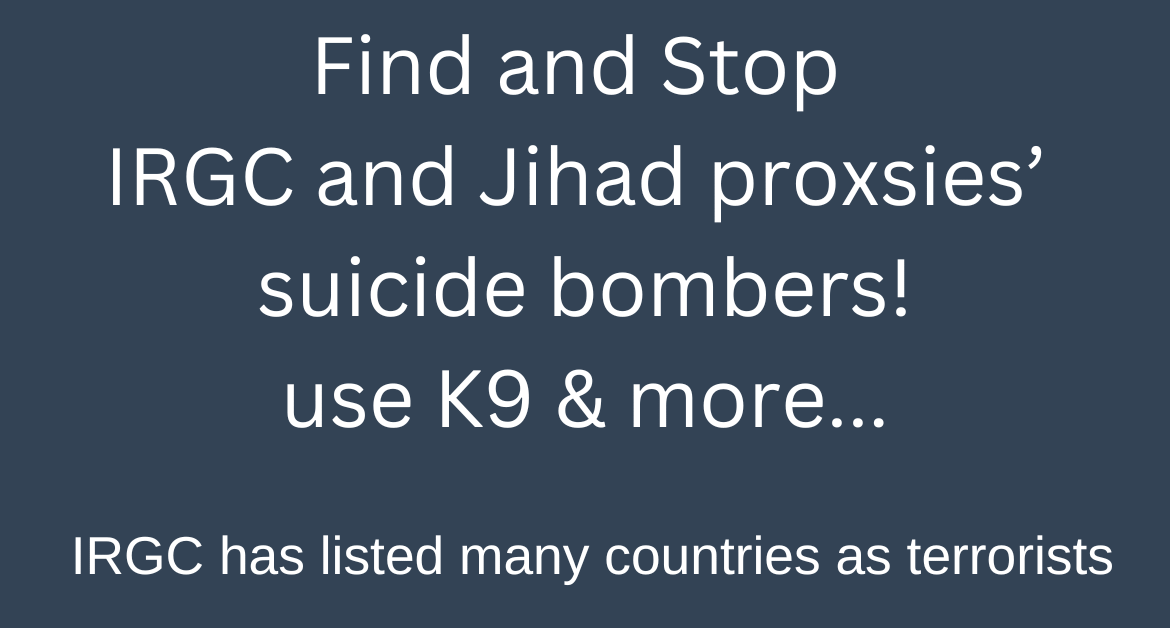
Countering Suicide Bombers
The countries of concern with regards the IRGC are the ones that the IRGC has listed as a terror organization because those countries listed IRGC as such.
Using K9 or other means for explosive detection to find suicide bombers be them in person or being transported by any type of vehicle should be considered.
The governmental bodies set and enforce rules and regulations for public and private security which could be state controlled or focused on private sector non-government institutes that set standards.
Each country has their standardised training for K9 explosive detection. For example, In the UK, the National Occupation Standards BS 8517 NASDU Level 4 certificate for explosive detection handler or for the Private Security Industry from the National Canine Training and Accreditation Scheme the NCTAS-P is the acceptable standard.
All earmarked countries by IRGC should have recognized standards for public and private security. Having said such, Pro-IRGC and their proxies will also target sites, communities and individuals in all other countries.
Now the issue is the nature of the suicide bomber.
When researching Intifada 1 and Intifada 2, (1987-1990, 2000-05) one could find a mixture of explosives that would trigger with alarm clocks besides the suicide bombers strapped up to manually self-detonate. The sites that were targeted was public transport and intermodal hubs besides restaurants, hotels and other public venues They were not primarily focused on the IDF but rather focused on the entire population.
Today, the suicide bomber can make use of more tools to achieve their objectives besides some sticking to the olden-day techniques. For this discussion, let us stick to physical security and focus on using K9 canine/dog explosive detection besides using fusional technologies.
There are sites of concern which are in line with the mission of the perpetrator. It would be highly probable today that the IRGC would target a military base to destroy assets just like what the Palestinian Action group did instead of painting the planes – they would simply blow it up. Also, consider that this applies also to the private sector sites that supply products or technologies to the military that was also done in the UK by the Palestinian Action group.
There are reputable security companies that provide services including K9 and have the technological capacities or there are in-house security professionals to do that job themselves. Regardless, the security is only as good as the way they think, how they perform and what tools they have.
Firstly focus on hardening by layering perimeter security. This could be from entry through the front door whereas security officers could search all people’s bags by hand and/or using metal detectors or x-ray machines.
Obviously, people can be screened by K9 canines that can also search vehicles arriving at the perimeter. Professional K9 handlers that are certified would know the methodologies and procedures to make their K9 canine mission ready and focused.
The question comes now, ‘what would the K9 handler do when explosives are detected on a suspected suicide bomber?’ Professionals in the field need to discuss how and what to do. For example, should the K9 immediately attack the assailant as soon as it picks up on the scent of the explosives?
Nevertheless, it is suggested to pay attention to the case studies in Israel during Intifada 1 and Intifada 2, whereas active suicide bombers were on mission. One case in particular was when a terrorist was taken down by a private security officer whilst keeping the detonator in the terrorists’ hand tightly closed.
When considering physical equipment and security technologies then we need to focus on new-age fusional (integrational) technologies working in concert together with other technologies that could identify the threat and automatically mitigate or lower the level of collateral damage. This could be when the explosive payload is being delivered in person or it could even be remotely delivered by a ‘toy’ drone for example.
ISIO |International Security Industry Organization is willing to consider endorsing, introducing and listing relevant stakeholders. ISIO in on mission with CAPSI, IFPO and SASA
(representing 10.2 million security professionals)